
Do nutrition labels work?
Do nutrition labels change what we eat, and can "accessibility nutrition labels" help create a more inclusive digital environment? Let's discuss.

As a kid, I wasn’t allowed to drink Coke or eat potato chips: they were unhealthy, as my granny would say, and full of chemicals! At the same time, my family was fine with me drinking uncoloured (and therefore, “healthy”) Sprite (we could afford a bottle once a year, when we came together for holidays), never questioned the benefits of orange juice, and added ungodly amounts of refined white sugar into their home-made deserts. In the late 90s, food labelling wasn’t exactly the top priority in developing countries, whose population struggled to make ends meet.
This newsletter remains free thanks to the power of will and passion for accessibility. You can support the author by buying him a cup of coffee.
Luckily, times have changed. Many countries have since rolled out and adopted food ranking systems to help promote healthier choices and “address the growing global concern of unhealthy diets”, to varying results. Reflecting on my personal purchasing habits, I noticed that certain low-ranking foods had effectively vanished from my shopping cart, and that when choosing between two nearly identical products, I am more likely to pick the one with the higher health score. Do nutrition labels actually help us pick healthier foods? Did they manage to cause a change in the food industry?
And most importantly, what does any of that have to do with accessibility?
Apple heart accessibility
Earlier in 2025, Apple released several features designed to make their digital products more accessible. Among other impressive upgrades, such as Magnifier for Mac and Braille Access, the company announced that accessibility labels were coming to the App Store. Apple called them Accessibility Nutrition Labels, designed to respect the consumer’s right to “know if a product or service will be accessible to them from the very start”.
The company choose a gentle approach to enforcing accessibility tagging, making them voluntary for now to give the developers time to adjust, assess, and improve their products, before eventually making them mandatory.
Earlier this year, we talked about the Accessible Games Initiative, a project backed by big gaming and tech companies, that is designed to help users identify essential features in games and inspire developers to pay more attention to accessibility.

The hopes in the industry are high: labels and the exact definitions they represent may not be universal across (for instance, Valve, as Laura Dale highlights, uses its own definitions and does not disclose them to the public) all marketplaces, but their very existence is seen by many (yours truly included) as the important step towards a more inclusive future. At first, the logic seems flawless: producers will dedicate more resources to accessibility to avoid being shamed and punished by both algorithms and users, and eventually, the customers will expect all products to be accessible by default.
But what if it wasn’t the case?
You are what you eat
Real world’s nutrition labels come in many shapes and forms, most common of which can be organised in two categories: reductive, providing a breakdown of nutrients contained in each serving, and interpretive, which evaluates the values against a certain standard and ranks them accordingly. While aiming to influence consumer behaviour, these two types of labels do so differently and, unsurprisingly, yield different results.
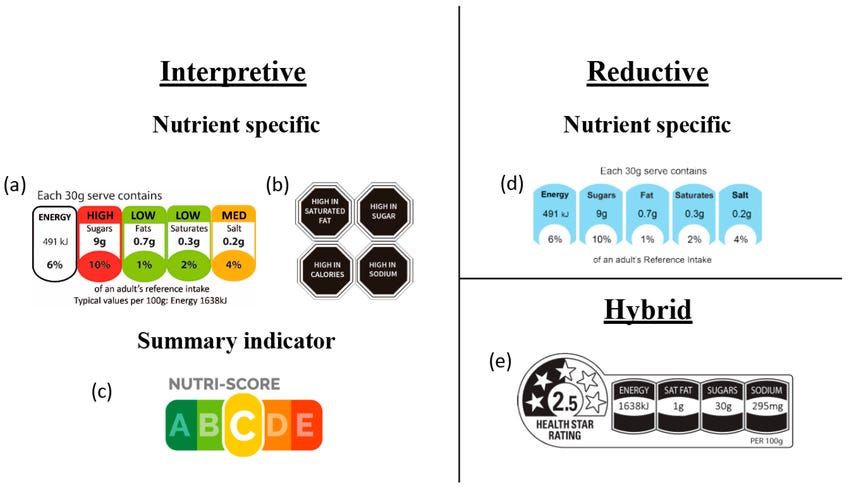
Assessing the efficacy of nutrition labels in changing consumer behaviour and food production is not easy: with so many financial, legal, cultural factors at play, deriving a definitive conclusion, universal for every context and every market, doesn’t seem possible. It does, however, seem feasible to at least find out which labels perform better.
A comparative study from 2011 by Findling et al., for instance, examined how participants reacted to five types of labels: single and multiple traffic light, nutrition facts (Facts Up Front), NuVal, and 0-3 star ranking. The researchers concluded that, although labels do improve the buyer’s understanding of the product’s nutritional quality, each method performed differently depending on the goals. For example, traffic light system and NuVal (a now defunct 1-100 ranking system) helped make simple choices between similar products. Similarly, a 2016 study showed the five-colour nutrition label to be the most effective among other options in promoting healthier choices.
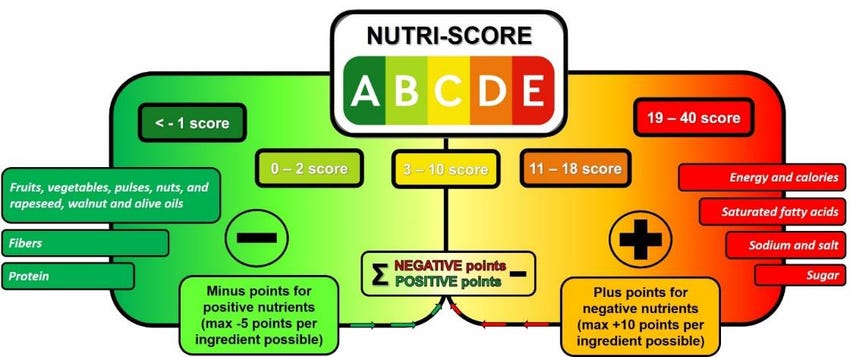
Although both studies assessed consumer’s intention, which may not necessarily translate into actual behaviour, a 2021 meta-analysis confirmed that certain labels (traffic light, nutrient warning, and health warning) are indeed associated with the increased probability of selecting healthier products.
Beside influencing the end consumer, food labels aim to change the industry as a whole. The results, however, are disappointing: a 2023 meta-study concludes that although food ratings is shown to impact the types of products consumers choose, the “magnitude of improvements” in the industry is small, noted in some categories as small reductions in sodium, sugar, and saturated fat.
What could possibly explain the industry’s reluctance to change?
It could be that food labelling remains a voluntary practice in many jurisdictions. A 2023 study by Ganderats-Fuentes and Morgan makes an interesting discovery: companies exploit voluntary labelling by choosing to label healthier products and skipping lower-ranking foods. Selective labelling leads to similar effects: Singapore’s Nutri-Grade requires all beverages to be ranked based on sugars and saturated fats content, but as a 2023 randomised study shows, this may not be enough to improve diet quality overall.

Another interesting observation, made by Ganderats-Fuentes and Morgan, is that companies (unsurprisingly) tend to push for reductive labels (simple badges without colour-coding, stars, or other symbols) that do not seem to have an impact on purchasing behaviour.
In conclusion, to maximise the impact of food labelling, we must, as the 2021 study concludes, make front-of-pack labels mandatory, and, as comparative research suggests, adopt interpretive labels that yield the best response from the local audience.
Once again, what does all that have to do with accessibility?
Making accessibility labels work
Accessibility labels — Apple’s Nutrition Labels and the Accessible Games Initiative’s game tags — are quite similar to their nutrition siblings: they encourage more inclusive choices, strive to change the industry, but most importantly, share similar limitations and problems.
First, existing accessibility labels are reductive: that is, they simply describe what features are present are absent, not attempt to rank the product’s overall accessibility against some standard. This is an obvious limitation that is, unfortunately, hard to overcome: digital products are complex and diverse, and a single “accessibility score” is not an easy task. That’s not to say that we have none, but perhaps, labelling will bring more attention to the existing ones and help develop new ones.

Second, labelling is voluntary: so far, Apple is the only company that is planning to make accessibility labels mandatory. Lack of unified standards and enforcement hinder the labels’ great potential, and once again, we can only hope that in time, developers will be required to mark inclusive features or lack thereof in their products.
Last but not least, labels are not visible enough. Games suffer the most as of today: Laura Dale writes that labels on Steam are not being “highlighted to disabled players who aren’t actively looking”, which, coupled with the lack of unified definitions, makes them infinitely less useful. Once again, Apple leads by example: Accessibility Nutrition Labels are hard to miss, as long as you are willing to swipe down to learn more about the app.
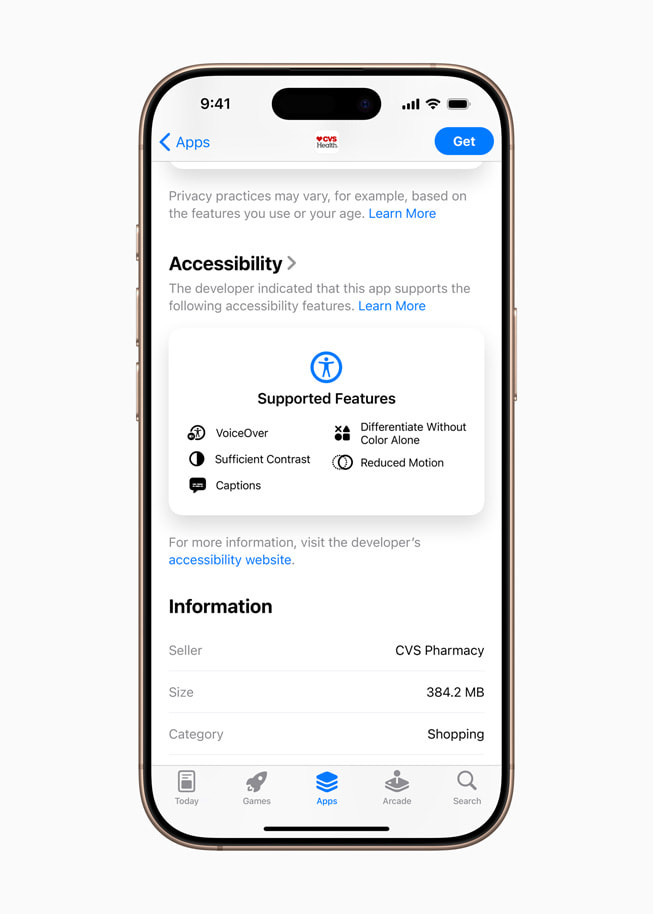
That being said, I sincerely believe that the addition of accessibility labels is a huge step towards a more inclusive tech industry. The transformation will not be immediate, we will have to overcome reluctance and resistance before we can develop more effective and visible labels with unified definitions and standards across the industry.
At least now, we are finally moving in the right direction.